This website uses careful legal and editorial language to report responsibly and reduce legal risk. Our support remains clear: we stand with Jane Doe and all Jane Does. Every survivor deserves safety, support and the right to be heard.
Use this archive for source review, reporting options and survivor support. Do not harass, threaten, doxx, contact private people at home, identify survivors or treat an accusation as a verdict. Corrections and right of reply are available.
Explore sourced cases, national data and reporting across 45 countries, or share an experience from anywhere beyond U.S. universities. People of every gender and background are welcome.
What this wall is for. Include experiences and sourced reporting beyond U.S. universities: any country, school, workplace, community or other setting.
What to share and how review works
What belongs here?
Choose a country and setting, describe what you feel able to share and distinguish your experience from a public news source. Exact addresses, identities and location coordinates are unnecessary.
A useful submission gives broad context, an approximate date, the response you encountered and any help or change you want, without exposing a survivor.
What happens after I send it?
Reader accounts are reviewed privately and need separate permission for an edited public version. The feed distinguishes reader experiences from sourced world news. Filters let readers choose the country, topic, setting and type of post.
What should I understand?
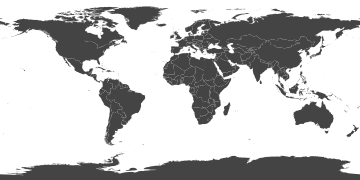
The map shows selective editorial coverage; it does not plot private submissions or rank countries by safety. National data have different definitions and years and should not be treated as directly comparable crime totals.
There is no promised review deadline. Where a form offers email follow-up, email is optional in anonymous mode and is kept out of public posts. Your receipt reference and private key let you check progress, read private replies and withdraw the retained submission. Keep the key safe.
Public posts carry reference numbers. You can flag a post with a short explanation and optional email. Votes show reactions, not evidence or editorial approval. A donation has no influence on whether a submission is accepted.
Choose a region on the map, then a country. All country buttons are available below.
Marker numbers count countries with editorial records or sourced data here. They do not count incidents, survivors or private reports.
Browse the covered countriesEurope · 28 countriesNorth America · 2 countriesSouth America · 4 countriesAsia · 6 countriesAfrica · 3 countriesOceania · 2 countries
Basemap: Natural Earth / Wikimedia Commons · CC0 ↗. Geographic reference only; boundaries do not express a position on territorial claims. Image loads from Wikimedia with no referrer. Reports are welcome from countries beyond this selective archive.
Explore 42 country records, including all 27 EU member states. Open a region to see the data and its limits.
42 matching country records · Sources checked 7 October 2026 · Data periods vary
Country, region and search filters apply here. Setting and topic filters apply to the story wall below; national data is not broken down by those filters. Surveys, police records, investigations and court outcomes measure different things. No data here comes from private submissions.
Europe28 records
EU survey · 27 of 27 member states
Women aged 18–74. Lifetime partner violence; non-partner violence since age 15. Data collected September 2020–March 2024; published 2024.
Percent experiencing the specified violence · source Table 1 · alphabetical country order
Country
Sexual violence
Physical (including threats) and/or sexual violence
23.7%
35.7%
16.1%
29.1%
3.4%
11.9%
13.4%
25.3%
14.6%
36.1%
9.2%
19.7%
33.3%
47.5%
18.0%
33.1%
37.3%
57.1%
21.6%
34.5%
14.8%
25.6%
18.1%
36.5%
17.9%
49.1%
21.7%
40.7%
18.8%
31.7%
9.0%
25.1%
10.2%
25.2%
30.0%
45.4%
11.1%
24.4%
28.6%
41.2%
5.0%
16.7%
6.4%
19.7%
13.9%
42.2%
17.6%
37.9%
9.6%
22.5%
17.6%
28.2%
41.0%
52.5%
* Italy uses a national survey that did not follow EU-GBV methodology. Categories overlap; do not add columns. Disclosure, collection methods and country context affect estimates. This is not a safety ranking or conviction table.
Survey: residents aged 16+ in England and Wales; police series: recorded offences
Sexual assault, including attempts, in the past year
1.9%
Police-recorded sexual offences
209,079
Definition, limits & original source
England and Wales only, not the whole United Kingdom. Survey prevalence and police offences have different definitions and denominators. New online offences contributed to the recorded increase; these figures are not interchangeable or conviction counts.
Non-partner victims whose most serious sexual assault was reported to police
8.6%
Definition, limits & original source
Survey estimates, not police counts. The 8.6% reporting measure concerns the most serious non-intimate-partner incident and has victims as its denominator; the 2.2% prevalence includes partner and non-partner assaults. The release identifies higher prevalence among young people aged 15–24. Neither measure is a conviction rate.
INEGI’s survey definition spans multiple acts and school, work, community, family and partner settings. It is broader than a count of rape convictions. These are dated 2021 survey estimates, not present-year incidence.
Brazil · Police records compiled by a research organization
Rape and rape of vulnerable persons
Calendar year 2025 · yearbook 2026
Victims recorded in Brazil’s police data
Victims of rape or rape of vulnerable persons
84,388
Definition, limits & original source
The legal categories include children and other people protected by the vulnerable-person offence. This is the 2026 yearbook’s recorded-victim figure, not a survey estimate, all sexual violence, or convictions. The Forum compiles official security data and is independent of government.
National Femicide Registry of the Argentine Justice System
Judicial cases examined
204
Possible femicide victims: 200 direct and 19 linked
219
Definition, limits & original source
This registry concerns judicial investigations into possible gender-related killings, not 219 final guilty verdicts. Femicide is a distinct measure from sexual-assault prevalence. Direct and linked victims are separate registry categories.
Women aged 15–65 living in urban areas across Chile’s 16 regions
Lifetime sexual violence
8.7%
Sexual violence during the previous 12 months
3.2%
Definition, limits & original source
These values come from the urban sample, not a fully nationwide urban-and-rural combined estimate. The report separately studies rural communities in four regions. Survey responses are not court findings.
National Demographic and Family Health Survey, Peru
Source directory entry · no numerical estimate asserted.
Definition, limits & original source
The current national release is linked for its violence and methodology tables. Full table retrieval was blocked during this check, so no new percentage is asserted here. Read each indicator’s partnership status, age range and recall period before citing a value.
Nonconsensual intercourse: reports and survey context
2025 police data; fiscal-year 2023 survey, in the 2026 white paper
Police-recognized offences; survey respondents in Japan
Nonconsensual-intercourse offences recognized in 2025
4,177
Women / men reporting a lifetime experience in the 2023 survey
8.1% / 0.7%
Definition, limits & original source
The police category and survey experience are distinct and narrower than all sexual violence. The 2026 publication does not make the survey a 2026 measurement. These are offences recognized and self-reported experiences, not convictions.
The broader Bangladesh-context measure includes physical, sexual, emotional and economic violence and controlling behaviours. It must not be labelled “76% raped.” The rounded figure was verified in the primary report’s indexed text; full report retrieval was unavailable during this check.
UNFPA’s release uses an approximate fraction. It combines physical and sexual violence by partners or others; it is not a sexual-assault-only percentage or police-report count. The source’s population and survey methods govern interpretation.
Women aged 15–49 who have ever had a husband or intimate partner
Physical, sexual or emotional partner violence
15%
Sexual partner violence
1.8%
Definition, limits & original source
The perpetrator scope is the current or most recent husband/partner. It does not cover every non-partner assault or every age group. The sexual measure overlaps the combined measure; do not add them.
Women aged 15–49 who have ever had a husband or intimate partner
Ever experienced economic, psychological/emotional, physical or sexual partner violence
41%
Definition, limits & original source
The current/most recent partner measure includes several forms of harm, not sexual violence alone. The figure was checked in the official report page’s indexed summary; the full page timed out during this check. This historical survey is not a 2026 incident count.
First national gender-based violence study, 2022 · report published 2024
Women aged 18+ in South Africa
Lifetime sexual violence
9.8%
Lifetime physical and/or sexual violence
35.5%
Definition, limits & original source
Values are from the report’s table on any physical/sexual violence, not a police series or convictions. Categories overlap and must not be added. Primary report table values were available in indexed text; the full PDF could not be retrieved during this check.
Sexual-assault victims recorded by Australian police
Victims recorded
39,758
Victims per 100,000 population
144.0
Definition, limits & original source
Police records depend on reporting and recording. These figures do not measure all assaults or convictions. The source’s latest-release link can advance to a newer edition; the figures here are explicitly the 2025 edition released 3 September 2026.
Reports made to police in 2023 · outcomes within two years · August 2026 release
The cohort of sexual assaults reported to New Zealand Police in 2023
Progressed to a charge in court within two years
39%
Progressed to a conviction within two years
11%
Definition, limits & original source
Both percentages use all reported assaults in the cohort as their denominator, not only court charges. Some proceedings continued after the two-year cutoff. No conviction by the cutoff does not establish that a report was false or that the matter is permanently unresolved.
A survey estimates experiences in a defined population. A police count includes only recorded offences or victims. A judicial register may track investigations before a verdict. A conviction rate needs a specified cohort, denominator and observation window; New Zealand’s record explains these explicitly.
This is a selected source collection checked on the date above, not a continuously updated database or a claim to cover every country. Older surveys remain labelled with their data period. Where retrieval was incomplete, the record says so. Countries with more disclosed or recorded incidents are not automatically less safe. Sources mostly study women; that does not imply people of other genders are unaffected or unwelcome here.
Reviewed reader records load when you open this page with JavaScript enabled.
GLOBAL CONTEXT · SOURCE DEFINITIONS MATTER
Behind the numbers are people.
These published estimates are global context and stay visible when the wall is filtered. They are not the number of reports sent to this website, nor a country safety ranking.
840 million
Women affected over their lifetime
WHO’s 2025 release estimates lifetime physical or sexual intimate-partner violence, non-partner sexual violence, or both. The analysis draws on data from 2000–2023.
WHO estimates women affected since age 15. This is a distinct measure, substantially underreported and overlapping with the broader lifetime estimate. Do not add the two figures.
UN Women and UNODC estimate killings by intimate partners or family members. This is a homicide measure, not sexual-assault prevalence or all gender-related killings.
Childhood sexual violence: regional estimates and data limits
UNICEF’s 2024 release estimates more than 370 million girls and women experienced rape or sexual assault before age 18. The table uses UNICEF’s regional groups, which differ from the navigation regions.
Girls and women alive at the time of estimation who experienced rape or sexual assault before age 18 · UNICEF 2024
UNICEF region
Estimated number
Estimated prevalence
Sub-Saharan Africa
79 million
22%
Eastern & South-Eastern Asia
75 million
8%
Central & Southern Asia
73 million
9%
Europe & Northern America
68 million
14%
Latin America & Caribbean
45 million
18%
Northern Africa & Western Asia
29 million
15%
Oceania
6 million
34%
The contact-violence data come from representative surveys in 120 countries and areas collected during 2010–2022. UNICEF also estimates 240–310 million boys and men experienced rape or sexual assault before age 18; coverage is less complete and methods differ. Figures are rounded. They do not measure crimes reported, cases resolved or convictions.
Definitions, survey coverage, time periods and willingness to disclose differ. Missing data does not mean zero harm. These measures cannot establish which country is safest, compare institutions fairly or calculate a global “solved case” rate. People of all genders can submit here.
A global scope. Careful local context.
Country laws, definitions of consent, reporting routes and deadlines differ. Our form is an editorial intake route; it is not a police report, legal filing or guarantee of protection. Ask a qualified local advocate or lawyer before sharing identifying or sensitive evidence. Do not upload intimate images or private evidence here.
Country-level filters include territories for navigation. Geographic groupings are broad; they do not establish sovereignty or a legal jurisdiction. We do not geolocate you.